
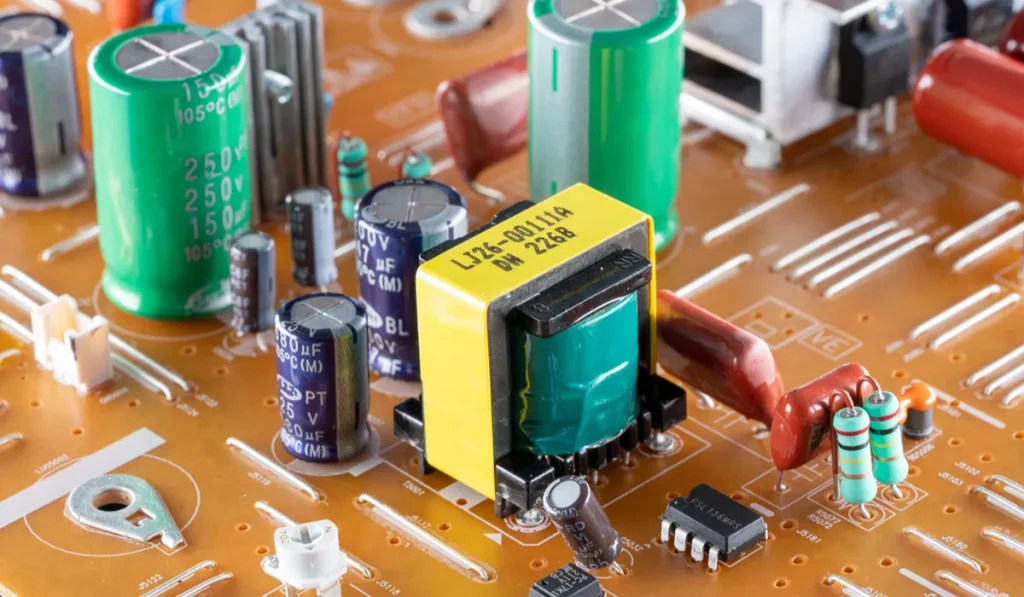
In power electronics, control governs how electrical energy is converted, regulated, and delivered to a load. Every application of power electronics involves some form of control. Control in power electronics determines how the power stage responds to input changes, load changes, faults, and performance requirements. It also coordinates how semiconductor switches, such as MOSFETs and IGBTs, are turned on and off to achieve the desired output voltage, current, or power.
Core Functions of Control in Power Electronics
Control in power electronics connects system requirements to power-stage behavior. It determines how switching devices respond to voltage, current, temperature, load demand, and fault conditions so the converter can operate within defined limits.
- Regulation of Voltage and Current – Control circuits adjust the switching patterns of power semiconductors to maintain output parameters within specified limits, even when input conditions or load demands change.
- Harmonic and Electrical Noise Reduction – Switching in power electronics can introduce harmonics, ripple, electromagnetic interference, or other power-quality concerns depending on the circuit and application. Control strategies help limit these effects, supporting stable power delivery and reducing stress on connected equipment.
- Efficiency Optimization – By precisely controlling switching times and duty cycles, control improves energy conversion efficiency and reduces losses.
- Protection and Safety – Control circuits monitor parameters like current, voltage, and temperature, and can limit operation or trigger shutdowns to prevent damage.
- Load Response and Stability – Control adjusts output in real time as load conditions change. It also helps the system respond to transients without excessive overshoot, oscillation, or unstable operation.
These control functions are implemented through physical electronics, not abstract logic alone. In many systems, that means one or more printed circuit board assemblies that carry the controller, gate drivers, sensors, protection circuits, communication interfaces, and supporting components. For OEMs, the reliability of control in power electronics depends partly on how those PCBAs are designed, assembled, inspected, and tested.
How PCBAs Support Control in Power Electronics
PCBAs used in power electronics control systems provide the hardware interface between control logic and the power stage, which is the high-power section of the circuit that performs the actual energy conversion. PCBAs may process sensor inputs, send switching commands, monitor operating conditions, and support communication with the larger system.
The board does not perform the full power conversion itself, but it provides the hardware needed to reliably execute and monitor control functions. Because these boards carry control, sensing, protection, and communication functions, assembly quality affects signal integrity, connection reliability, and the consistency of control performance in the finished system.
Feedback and Sensing Circuits Give Control Systems Usable Data
Control in power electronics depends on sensing circuits to provide accurate feedback. A PCBA may include or connect to sensing circuits that measure voltage, current, temperature, position, speed, or fault conditions. The controller compares the measured value to the desired setpoint and adjusts switching behavior, limits output, or initiates a shutdown when the operation moves outside defined limits. The cycle continuously repeats, allowing the control system to make corrections without manual intervention.
In a simple DC motor control system, for example, current sensors monitor load current, and speed and position sensors track rotation. The control uses sensor feedback to adjust the voltage or current to maintain the motor’s desired speed and torque.
Gate Driver and Switching Circuits Connect Control Logic to the Power Stage
In many power electronics systems, the controller cannot directly drive the switching devices. Gate driver circuits translate low-power control signals into the voltage and current needed to turn MOSFETs, IGBTs, or other power switches on and off. The timing and consistency of those signals affect switching behavior, efficiency, heat generation, and electrical noise.
At the PCBA level, the gate driver circuit depends on accurate component placement, reliable solder joints, controlled spacing, and clean signal paths so switching commands can move from the controller to the power stage without unintended delay, noise, or connection issues.
PCBA Assembly Considerations for Control Reliability
Control PCBAs must preserve signal paths, feedback accuracy, driver timing, protection behavior, and communication between the controller and the power stage. These boards may carry low-level sensor signals near higher-energy switching circuits, so assembly quality affects more than whether components are attached correctly. Placement accuracy, solder quality, connector integrity, contamination control, and spacing can affect signal integrity, feedback paths, isolation, and protection circuits.
Consistent assembly also matters because small changes can create inconsistent control behavior from one build to the next. A marginal solder joint, misaligned component, contaminated surface, or poorly seated connector may affect feedback accuracy, switching commands, fault detection, or communication with the larger system. For OEMs, the assembly process must preserve the control system’s design intent from prototype through repeat builds.
Working With an EMS Partner on Control PCBAs
For OEMs, control PCBA production requires clear communication between engineering and manufacturing. The EMS partner needs to understand which circuits carry sensitive feedback signals, which components support switching or protection, and which tests confirm that the board performs as intended. SMTNW supports PCB assembly with process control, inspection, testing, and communication throughout the build, helping customers move control PCBAs from prototype to repeat production with fewer avoidable production issues.
Contact SMTNW to discuss control PCBA assembly, inspection, and testing for your next build.