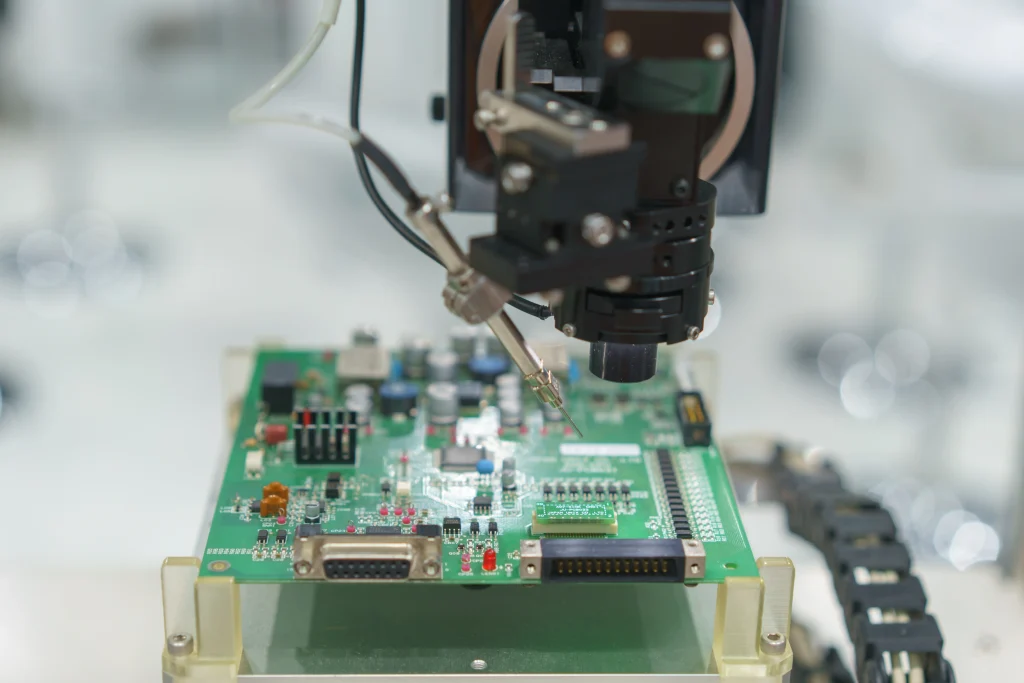
Stencil Framing and Print Setup
Automated PCB assembly depends on a controlled setup before components are placed. Including stencil framing as part of that setup helps support more consistent solder paste disposition and a more repeatable foundation for fine-pitch parts, dense layouts, and assemblies where solder paste accuracy affects downstream placement and reflow results.
Automated Component Storage and Retrieval
Accurate automated electronics assembly starts with controlled material handling. Our automated component storage systems and dry storage systems keep moisture-sensitive components organized, accessible, and protected. Automated component storage helps reduce time spent locating parts and lowers the risk of missing, misplaced, or uncontrolled components delaying a build.
Material control also affects whether builds start on time and move through production without interruption. Keeping components organized, accessible, and verified before release to the floor helps reduce delays tied to missing or misplaced parts and supports a more predictable assembly schedule.
Automated SMT Placement
Our automated SMT lines support fine-pitch placement, bottom-terminated components, and a wide range of board and panel sizes. Our equipment allows us to place up to 300 unique components and achieve up to 60,000 placements per hour across our lines.
The value of automated PCB assembly is component placement consistency. It helps ensure components are placed accurately, soldered correctly, and inspected before the assembly moves forward.
Programmable Reflow
Programmable reflow is a critical part of automated electronics assembly. After placement, SMT assemblies move through reflow ovens. We use programmable 7-zone and 9-zone reflow ovens to control soldering profiles for leaded and lead-free assemblies.
Programmable reflow gives the team control over the soldering profile used for each assembly. That control is important for boards with fine-pitch parts, dense layouts, mixed packages, and temperature-sensitive devices. It also supports more consistent solder joint formation across different build requirements.
3D Automated Optical Inspection
Once boards complete SMT placement and reflow, AOI helps verify component presence, orientation, placement, and solder quality before assemblies move forward. As part of our automated PCB assembly process, we perform 100 percent AOI.
This inspection step identifies issues early, improves reliability, and ensures only conforming assemblies move to the next stage.
Selective Soldering for Through-Hole and Mixed-Technology Assemblies
For assemblies that combine SMT and through-hole components, programmable selective soldering enables a more controlled, repeatable soldering process by giving the team more control over solder application, dwell time, travel, and other process variables. That supports repeatable results while reducing dependence on fully manual soldering methods.
What Automated PCB Assembly Means For Customers
Automated PCB assembly reduces avoidable variation in production. Automated placement improves consistency. Automated component storage improves material control. Programmable reflow supports repeatable soldering conditions. AOI adds a defined inspection checkpoint before assemblies continue through the process.
The result is a more controlled and reliable electronics assembly process, with consistent quality across each build. By integrating automation at every stage, we enable repeatable production and defined verification points throughout the assembly process.
Need A More Controlled, Automated Assembly Process?
If you are evaluating an electronics manufacturing partner for SMT, mixed-technology, or inspection-driven builds, we can help you review your requirements and determine the right process for your assembly. Contact us to discuss your board design, production needs, and quality requirements.