
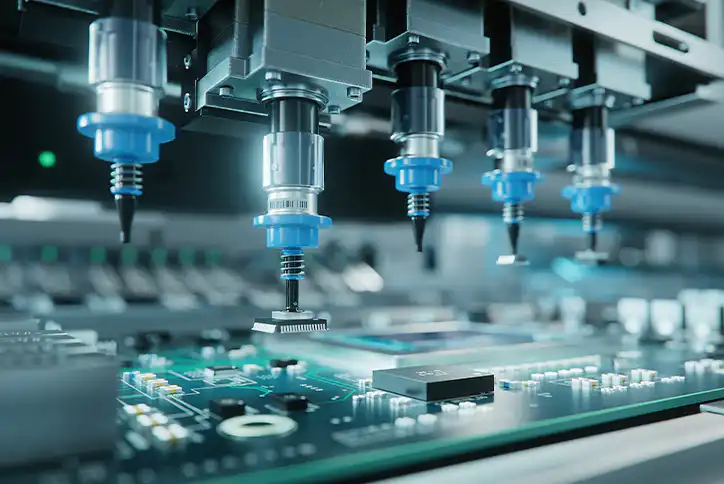
As demand for automation; IoT and connected devices; consumer and industrial electronics; and other compact, high-performance electronics has risen, surface-mount technology (SMT) has dominated the PCBA market and is expected to continue growing. SMT assembly services support advanced miniaturization, enabling manufacturers to place smaller, more densely packed components directly onto PCBs. This results in higher circuit complexity, improved performance, and greater design flexibility, which are essential for modern electronics.
What SMT Assembly Services Include
Unlike traditional through-hole assembly, SMT assembly services involve placing components directly on the PCB surface. This approach enhances efficiency and scalability while ensuring reliable, repeatable results essential for critical applications in both consumer and industrial sectors.
SMT assembly begins with the application of solder paste, which is small particles of metal solder suspended in flux. A stencil is used to deposit solder paste precisely where surface-mounted components will be placed. Precision placement and controlled volume of solder paste prevent defects, such as bridging and insufficient solder joints. Once the components are placed by an automated system, reflow solder occurs, where the board is heated in a controlled manner so that the solder paste melts and the components are secured to the board.
Automated 3D optical inspection (AOI) uses a series of cameras to visually inspect each assembly and verify component placement and orientation, as well as solder quality. Electrical testing verifies board functions as designed before shipping.
Why Process Control Matters in SMT Assembly
SMT assembly services depend on repeatable controls at each step of the PCB assembly process. Small changes in solder paste volume, placement accuracy, oven temperature, material handling, or inspection criteria can affect yield, reliability, and long-term PCBA performance.
Solder paste printing is closely monitored because paste volume directly affects solder joint quality. Area, thickness, and volume must stay within defined limits to prevent insufficient solder, solder bridging, and related defects. When solder paste results begin to drift toward an upper or lower control limit, engineers can evaluate stencil wear, squeegee pressure, print speed, paste condition, or other process variables before defects affect an entire batch.
Pick-and-place equipment must also be controlled and verified. Modern SMT machines can place tens of thousands of components per hour, but speed only matters when placement remains accurate and repeatable. Calibration, fiducial recognition, feeder setup, nozzle condition, component orientation, and X-Y alignment all help prevent missing, shifted, reversed, or incorrect components.
Reflow soldering uses controlled heat to melt the solder and attach components to the PCB. The oven’s temperature zones must be profiled and monitored to prevent defects such as poor wetting, tombstoning, thermal stress, and solder joint weakness. The reflow profile should account for board size, component mix, solder alloy, and thermal sensitivity.
Process control also includes how materials and assemblies are handled before and after placement. Solder paste storage, component traceability, ESD protection, moisture-sensitive device handling, and cleanliness can all affect assembly quality. These controls are especially important for high-performance PCBAs where latent defects may not show up until the assembly is in use.
Inspection and testing provide another layer of control. Depending on the assembly requirements, this may include solder paste inspection, automated optical inspection, X-ray inspection, first-article inspection, in-circuit testing, or functional testing. These steps help confirm that the process is producing assemblies that meet workmanship and performance requirements.
Employee training should also be part of a controlled SMT assembly process. IPC-A-610 is the most widely used industry standard for assessing the acceptability of electronic assemblies. It gives inspectors and production teams a common reference for evaluating solder connections, component mounting, and overall assembly workmanship.
What Applications Benefit from SMT Assembly Services
SMT assembly services are often used for electronic products that require compact design, consistent performance, and repeatable production quality. Because surface-mount components are placed directly on the PCB, SMT assembly can support high component density without increasing board size. This makes it useful for products where space, weight, reliability, and production consistency matter.
Commercial electronics often benefit from SMT assembly because many products require compact circuit boards, consistent performance, and scalable production. This can include control boards, communication devices, display electronics, handheld equipment, and connected products used in business or institutional settings. SMT assembly helps support smaller product designs while maintaining repeatable component placement and solder joint quality.
Power distribution equipment may use SMT assembly for control, monitoring, communication, and protection circuits. While high-current connections and larger power components may still require through-hole mounting or mechanical fastening, SMT is commonly used for the supporting electronics on the PCB. These assemblies may help monitor voltage, current, temperature, fault conditions, or system status.
Industrial control and monitoring products can also benefit from SMT assembly services. These systems often include PCBAs used for automation equipment, machine controls, interface modules, data acquisition, and equipment monitoring. SMT assembly supports dense, repeatable board layouts while helping manufacturers produce consistent assemblies across prototype and production runs.
For companies developing electronic products, SMT assembly services are most valuable when the design requires smaller boards, higher component density, repeatable production, or reliable field performance.
SMTNW For Reliable SMT Assembly Service
SMTNW provides SMT assembly services for companies that need reliable, repeatable PCB production for commercial electronics, power distribution electronics, industrial controls, monitoring products, and related applications. From solder paste application and component placement through reflow, inspection, and electrical testing, controlled assembly practices help reduce defects and support consistent PCBA performance. Whether the project involves a new build, production support, or a compact assembly with tight placement requirements, SMTNW can help review the assembly needs and determine the right production approach.
Contact SMTNW to discuss your PCB assembly requirements and learn how its SMT assembly services can support your next project.