
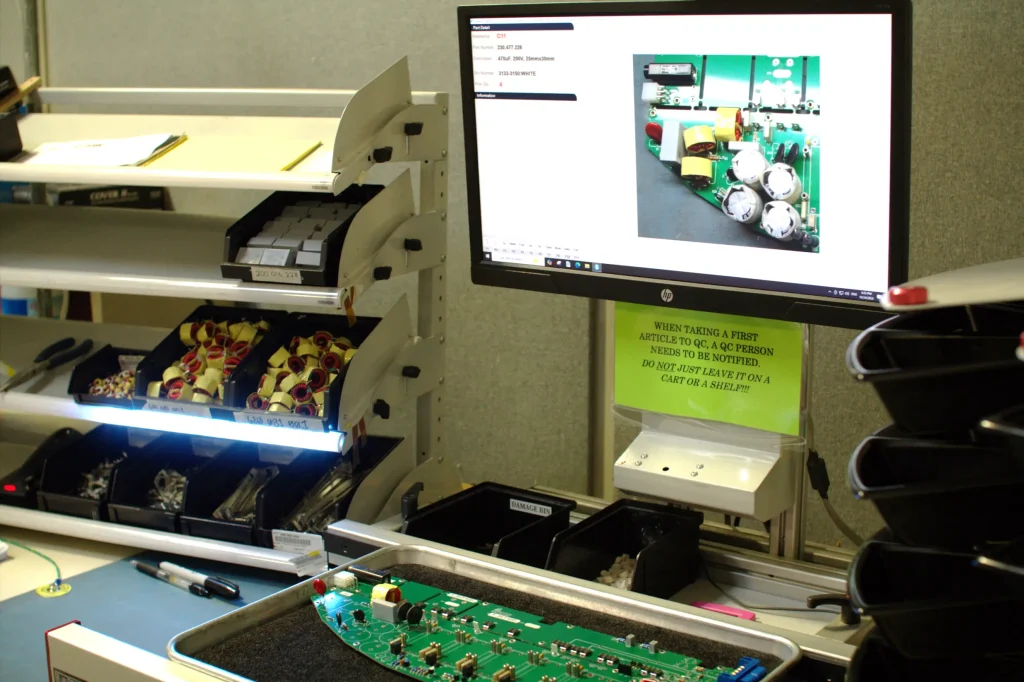
Through-hole PCB assembly was the dominant method for manufacturing printed circuit boards until the 1980s. With the rise of the Walkman and early cell phones, demand for smaller boards increased, prompting manufacturers to shift to surface-mount technology. In modern electronics, surface-mount technology dominates the market, accounting for over 90% of all board assemblies and capturing roughly 72% of market revenue in 2025. Through-hole PCB assembly accounts for the remainder and has many advantages for the right applications.
Understanding Though Hole PCB Assembly
A PCB is made up of one or more layers of electrical conductors separated by insulating materials. In through-hole PCB assembly, engineers create a board layout, determine component placement, and precisely drill holes into the board. Holes used for electrical connection and component mounting are plated with copper. This allows electrical signals to travel between different layers of the board or connects component leads to the circuit. Most modern boards (especially multi-layer boards) use these to ensure reliable electrical connectivity. Non-plated though holes are used for mechanical purposes, such as mounting holes for screws or tooling holes used for assembly machines.
Component leads are inserted through the plated holes to be soldered into place. These components include resistors, capacitors, diodes, inductors, integrated circuits, transistors, connectors, switches and buttons, relays, and transformers. There are two types of lead configuration: axial and radial lead. For axial leads, one wire comes out of each end (like a classic resistor). The component usually lies flat against the board. With radial leads, both wires come out of the same side (bottom). The component stands upright like a water tower.
Soldering for through-hole PCB assembly is a highly automated process primarily handled via wave soldering. After components are inserted into the board, the assembly travels on a conveyor over a standing wave of molten solder. Through capillary action, the solder wicks into the plated holes, filling the barrel and creating a robust mechanical and electrical bond spanning the entire thickness of the PCB. For complex boards that also feature surface-mount parts, providers use selective soldering to prevent heat damage to nearby SMT components while maintaining the high structural integrity required for connectors and power parts.
Why Through-Hole PCB Assembly Still Matters in Modern Electronics
Through-hole PCBs play an important role in products that demand durability, mechanical stability, and long-term reliability. The physical durability and power capacity cannot be matched by surface mount technology.
Some components are exclusively through-hole due to their size and weight. These include high-current connectors, large transformers, large electrolytic capacitors, and heavy-duty relays.
In surface-mount technology, components are held by a thin layer of solder on the surface that can shear off. Because through-hole technology components are anchored through the board, the attachment is significantly stronger. This works particularly well for the heavier or taller components mentioned above or for products that require higher durability and reliability than surface mount technology can provide.
Industries and products using through-hole technology most often include:
- Industrial & Aerospace: Heavy machinery and satellites deal with extreme vibration and G-forces that would crack brittle surface-mount technology solder joints.
- Power Electronics: Electric vehicle chargers, power grid transformers, and high-wattage amplifiers use through-hole technology to handle high heat and high current without melting the board.
- Consumer Hardware with High Interaction: Desktop PCs (for GPU slots and RAM DIMMs), guitar amplifiers, and appliances (washing machines and microwaves) where buttons and connectors take constant abuse.
- Military & Defense: Used for ruggedized gear designed to survive explosions or extreme environmental shifts.
Benefits of Through-Hole Assembly
Through-hole technology has several benefits, especially in applications where strength, reliability, and power handling matter more than maximum miniaturization:
- Stronger mechanical attachment: Component leads pass through the PCB and are soldered on the opposite side, creating joints that generally tolerate shock, vibration, and mechanical stress better than surface-mount-only joints.
- Better for high-power and high-voltage parts: Through-hole technology is commonly preferred for connectors, transformers, and large capacitors, where current-carrying capacity, spacing, and heat dissipation are key considerations.
- Durability in harsh environments: Often used in automotive, aerospace/defense, industrial, and some medical products, where long service life and resistance to vibration/thermal cycling are key.
- Easier prototyping and rework (in many cases): For hand-assembly and low-volume builds, through-hole parts can be easier to handle and inspect; some repairs can be simpler (though dense multi-layer boards can still be challenging).
- Hybrid design flexibility: Many real products use SMT for density plus through-hole for mechanical/power-critical components, giving a good balance of cost, size, and reliability.
SMTNW Is Your Trusted Specialist in Robust Through-Hole Technology Solutions
At SMTNW, we deliver comprehensive through-hole services tailored to your needs, including rework, in-line insertion, and selective soldering. Our skilled team backs these offerings with hand-soldering expertise, rework certification, and mechanical assembly capabilities. We also provide wiring and box builds, ensuring robust solutions for every application. When you choose us, you benefit from our commitment to quality and reliability at every step. Contact us for a quote.