
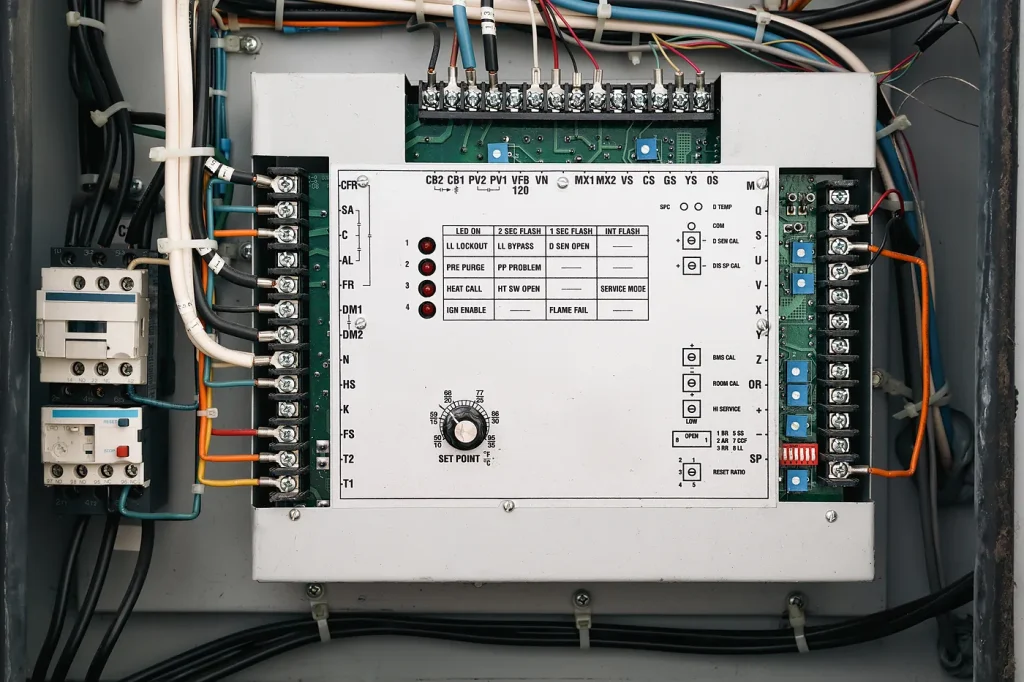
Industrial equipment for control systems, power equipment, and automation depends on electronics that can perform consistently over long production runs and demanding operating conditions. A control system may monitor temperature, pressure, current, position, or other operating conditions. A power distribution system may depend on a PCBA for monitoring, protection, communication, or control. Automation equipment may require multiple boards to work together to manage sensors, motors, interfaces, and other functions. For the companies that manufacture this equipment, choosing an appropriate manufacturing approach for the electronics is an important part of getting the product into production. Industrial PCBA solutions need to account for the design itself, the mix of components, production volume, inspection requirements, and how the finished assembly will be integrated into the larger piece of equipment.
SMT and Through-Hole Components May Work Together
Industrial PCBAs frequently contain a combination of surface-mount and through-hole components. SMT is well suited to smaller components and densely populated circuit boards, while through-hole components can provide mechanical strength or accommodate larger components, which means an industrial electronics manufacturer may need more than a surface-mount production line. The assembly process needs to accommodate the complete bill of materials and the board’s physical requirements. For example, a board could contain hundreds of smaller SMT components alongside larger connectors, terminals, or other through-hole parts. The manufacturing process needs to maintain consistency across both technologies rather than treating them individually.
Selective soldering can also be useful for mixed-technology assemblies. Instead of exposing the entire board to another soldering process, selected through-hole connections can be soldered where needed.
Industrial PCBA Solutions Depend on Inspection
Inspection is particularly important when a PCBA is required for equipment that is expected to operate for years. A problem that is caught during manufacturing is generally easier to address than one discovered after the board has been installed. Automated optical inspection can identify issues involving component presence, orientation, placement, and soldering. Three-dimensional AOI can provide additional information about solder joints and component placement. X-ray inspection can be useful for examining connections that cannot be fully evaluated through conventional visual inspection.
The appropriate inspection approach depends on the assembly. A densely populated SMT board, a board with hidden solder joints, and a mixed-technology assembly may each require different inspection considerations. Inspection also works best when it is part of a controlled manufacturing process rather than treated as a final step alone. Incoming component verification, controlled material handling, assembly process controls, and inspection throughout production can help identify problems before they move further through the process.
Production Requirements Can Change With Volume
An industrial equipment manufacturer may start with a relatively small production run and later need to build considerably more units. The manufacturing process needs to support that transition without introducing unnecessary variation. Automation can help provide repeatability as production volumes increase. Automated component placement, controlled soldering processes, automated inspection, and machine-guided insertion can reduce some of the variation associated with manual processes.
At the same time, not every industrial product is produced in high volumes. High-mix, lower-volume production can require a different approach, particularly when an EMS provider is manufacturing several different assemblies with different bills of materials and production requirements. It is important to use the appropriate manufacturing processes for the product and its production requirements.
Consider the Complete Assembly
An industrial PCBA doesn’t exist in isolation. It is a component of a larger system and may be inserted inside a larger enclosure, connected to other boards, wired into sensors, or integrated into a machine. Because the electronics manufacturer typically has visibility only into the PCBA, communication between the OEM and the electronics manufacturer is important. Information about connectors, wiring, mechanical requirements, testing, component availability, and production quantities can affect how the assembly is manufactured.
For some products, the electronics manufacturer may also handle related mechanical assembly, wiring, or box builds. This not only provides the electronics manufacturer with deeper insight, but it also allows the OEM to receive a more complete assembly rather than managing every manufacturing step separately.
Industrial PCBA Manufacturing Requires the Right Fit
Industrial PCBA solutions need to match the application, the board design, and the production requirements. Surface-mount assembly, through-hole processes, selective soldering, inspection, automated assembly, and production controls can all have a place depending on the product.
SMTNW manufactures PCB assemblies for industrial applications, including precision control systems, power distribution equipment, analysis equipment, and robotics. Its capabilities include SMT and through-hole assembly, selective soldering, machine-guided insertion, automated assembly, and inspection processes.
If you are developing or producing electronics for industrial equipment, contact SMTNW to discuss your PCBA manufacturing requirements and production needs.