
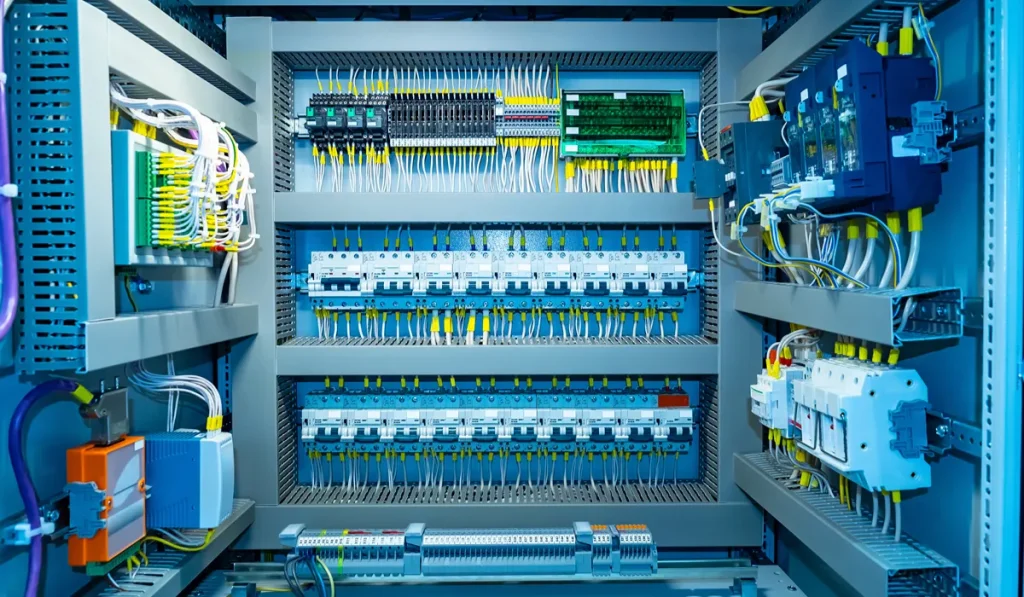
Custom power distribution equipment is designed to monitor, control, protect, and distribute electrical power based on application-specific requirements. Custom equipment (switchgears, panelboards, PDUs, motor control centers, and unit substations) address the unique load profiles, physical constraints, environmental conditions, and compliance requirements that standard configurations can’t meet. The technology that makes it all work includes PCBAs that handle monitoring, control, protection logic, communication, and power conversion. Here, we will explore what those assemblies do, what makes them technically demanding, and what OEMs should consider when sourcing PCBA assembly for power distribution applications.
Types of PCBAs in Custom Power Distribution Equipment
There is no single type of PCBA in power distribution equipment, because these systems do more than just route power from one point to another. They measure electrical conditions, trigger protection responses, support local and remote control, and communicate operating data to other systems. The board design depends on what the equipment is expected to monitor, control, protect, or report. In custom power distribution equipment, PCBAs commonly fall into several functional groups:
- Control Boards — Serve as the central processing unit for the equipment, coordinating breaker operations, load management, transfer switching, sequencing, and system automation based on programmed logic and real-time inputs.
- Protection and Relay Logic Boards — Execute overcurrent, ground fault, and arc-flash protection algorithms; interface with CTs and PTs for real-time measurement. These boards help prevent equipment damage, reduce downtime, and improve personal safety by detecting abnormal conditions and triggering protective actions before failures escalate.
- Monitoring and Metering Boards — Voltage, current, power factor, energy measurement; feed data to local displays and upstream SCADA/BMS systems. The information they collect supports energy management, predictive maintenance, and troubleshooting efforts across facilities and utility networks.
- Communication/Networking Boards — Modbus, Ethernet/IP, CAN, RS-485 interfaces that connect distribution equipment to building management, industrial control, or cloud monitoring platforms. Without these interfaces, remote monitoring, centralized control, and data collection would not be possible.
- Power Conversion and Conditioning Boards — DC power supplies for internal control circuits, voltage regulation, and UPS interface boards. Stable power is essential for reliable operation, especially in environments where voltage fluctuates, surges, or electrical noise is present.
- Human-Machine Interface (HMI) Boards — Local touchscreens, indicator panels, alarm annunciators. These boards give operators visibility into system conditions and provide a direct way to configure, monitor, and troubleshoot equipment.
What Makes Power Distribution PCBAs Different from Standard Assemblies
PCBAs used in power distribution equipment operate in environments where reliability, electrical isolation, and long service life are critical. Unlike many general-purpose electronic assemblies, these assemblies must withstand higher voltages, electrical noise, temperature variation, and demanding operating environments while continuing to perform protection monitoring and control functions.
Power distribution PCBAs often require the following:
- Higher Current Requirements — many power distribution applications require PCB traces to carry significantly more current than traditional control or consumer electronics. This often leads to heavy copper weights, wider traces, and designs that help manage heat generation and electrical resistance.
- Increased Electrical Isolation — Custom power distribution equipment often operates at higher voltages than standard electronic products. Designers must account for creepage and clearance distances, insulation requirements, and isolation barriers to help prevent arcing and unintended current paths.
- More Robust Components — These assemblies often incorporate larger connectors, relays, transformers, current sensors, and power management components. Mixed SMT and through-hole construction is common because some components must withstand higher mechanical and electrical loads.
- Thermal Management Considerations — Current flow generates heat. Power distribution PCBAs may require thicker copper thermal vias, heat sinks, or specialized layouts to maintain safe operating temperatures and protect component life.
- Higher Reliability Expectations — A failure in a power distribution system can affect equipment availability, production, operation, or safety systems. As a result, OEMs often require more extensive inspection, testing, traceability, and quality controls than those used for many commercial electronics.
Manufacturing Considerations For Power Distribution PCBAs
The design requirements of custom power distribution electronics directly affect manufacturing. Higher-current circuits, larger power components, and electrical isolation requirements often require careful process control, inspection, and testing to help ensure reliable field performance. Assemblies used in monitoring, protection, and control applications often contain a mix of power-handling components, communication interfaces, sensors, and processing electronics that must operate reliably over a long service life.
Expectations for manufacturing power distribution PCBAs include:
- Mixed SMT and Through-hole Assembly — Power distribution PCBAs frequently combine surface mount components with larger through-hole components. The manufacturing process must support both assembly methods while maintaining consistent solder quality and mechanical strength.
- Inspection and Functional Testing — Because these assemblies often support critical monitoring and control functions, inspection and testing are important in the manufacturing process. Automated optical inspection (AOI), in-circuit testing, and functional testing can help verify that assemblies perform as intended before they are integrated into the final system.
- Long-term Reliability — Power distribution equipment is commonly expected to remain in service for many years. Manufacturers must consider component availability, process consistency, and quality controls that support long-term product reliability and reduce the risk of field failures.
Talk With SMTNW About Power Distribution PCBA Assembly
Custom power distribution equipment depends on PCBAs that can support control, monitoring, protection, communication, and long-term field reliability. SMTNW helps OEMs build these assemblies with controlled SMT and through-hole processes, inspection, testing support, and clear communication throughout production. Contact SMTNW to discuss your power distribution PCBA assembly requirements and review the best path for your next build.